
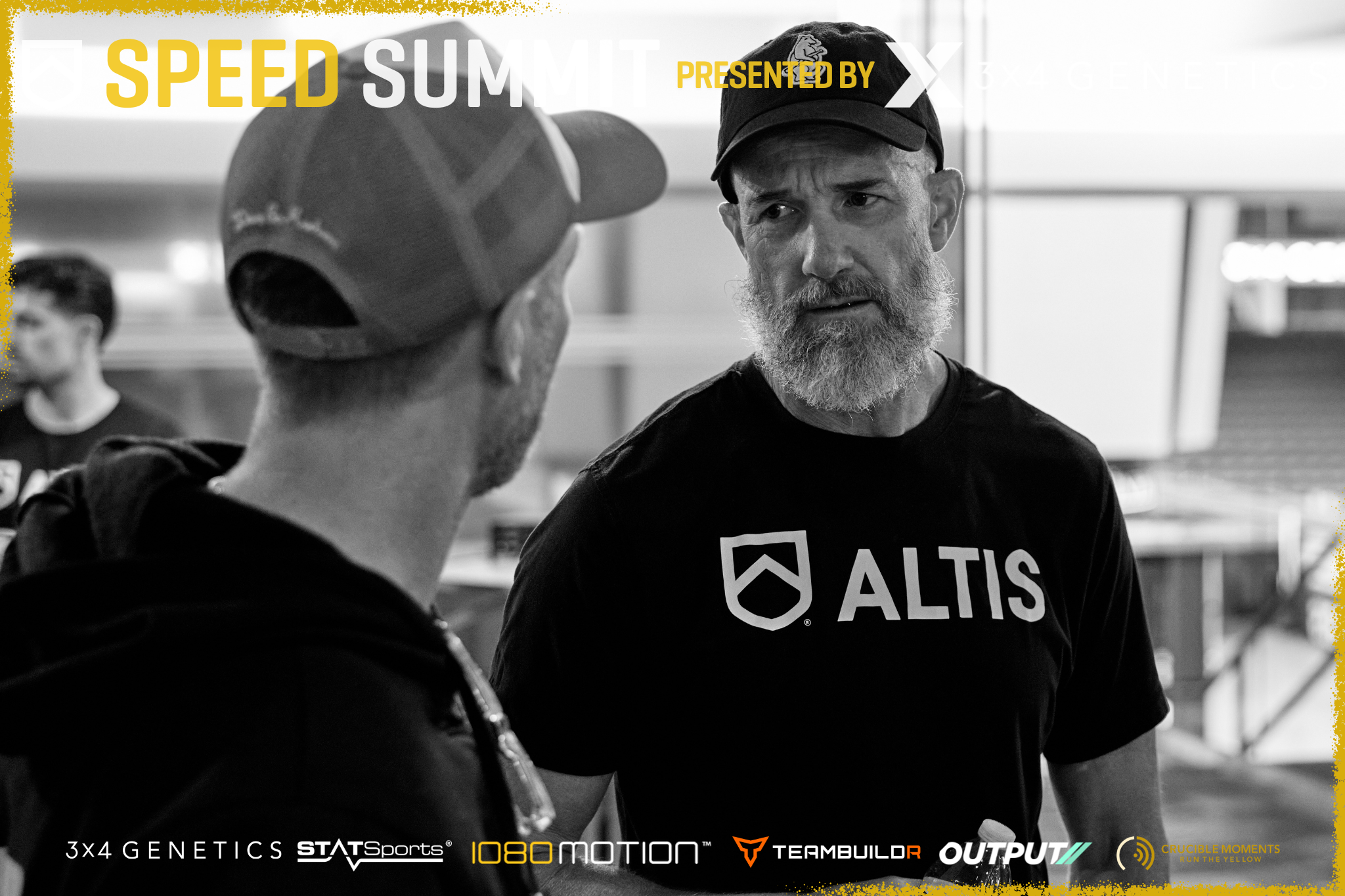

Well… that escalated quickly.
Yesterday, we shared a short clip from Stu McMillan’s Speed Summit session. In it, he said:
“If anything you take from this — just please stop doing A-drills and wall drills… You’re wasting your time.”
Within hours, the comments were busy; curious coaches weighing in from every angle. Some applauded it. Others strongly disagreed. Many wanted to know the reasoning behind it.
And that’s the thing; the clip you saw was lifted from the middle of a much larger conversation about the coordination patterns that drive upright sprinting.
As author and communication scholar Neil Postman once wrote:
“You can’t get the whole truth in a sound bite. You can only get a fragment, and fragments without context can be misleading.”
That’s why we’re sharing the full context here: because at ALTIS, our focus is not on quick takes, but on delivering deep, educational insight you can use in your coaching.
From Shapes to Patterns
In the full presentation, Stu broke sprinting down into:
Primary shapes – the key positions every sprinter hits in the gait cycle:
- Touchdown – foot first contacts the ground.
- Mid-support – foot directly under the centre of mass.
- Toe-off – foot leaves the ground.
- Maximal Vertical Projection (MVP) – hips at their highest point.
Secondary patterns – the coordination that connects these shapes in space and time:
1) Hip Extension – from mid-support to toe-off, thigh driving back behind the hip.
“If you do not extend your hip well, you do not run fast. This is the most important pattern by far."
2) Hip Flexion – from toe-off to the block in front, thigh swinging forward.
“It’s about 50% of the gait cycle — but that doesn’t mean it’s important. I can do it as well as Noah Lyles, and he’d still beat me by seven seconds.”
3) Foot-to-Ground Interaction – from late swing through braking to mid-support.
“Upwards of 80% of hamstring injuries happen here. How you hit the ground matters for both speed and health.”
4) Spinal Engine – the oscillation of the hips and shoulders through the spine.
The key point: patterns - or how well an athlete moves between shapes - matter more for speed than the shapes themselves.
The Section in Question
Here’s the part of the talk we shared:
“Now think about the drills that you do to try to improve sprint speed. Are they hip extension drills or hip flexion drills?
They’re hip flexion drills.
I’ll answer your question for you — you’re doing hip flexion drills.
You’re doing A-skips and A-marches and A-runs and wall drills all to improve this hip flexion capacity that just is not important at all.
You’re wasting your time.
Every hip flexion drill that you’ve ever given an athlete — you’ve wasted that 5 minutes or 10 minutes or half an hour that you’ve spent doing it.
Stop it.
Or if you do, just make sure you’ve got a really good why behind it. Think about why am I doing this? Don’t focus on what this thing is — why is it?
And then ask why again, and then why again, and then maybe why again. And if you can get to the fourth and fifth why and you’ve still got a justification for why you’re doing a hip flexion drill, great — go and do it. But ask the question first.”
Not a Blanket Ban
Stu was clear this isn’t about removing all drills from a program. It’s about matching exercises to the patterns that truly limit performance.
“If you’re working with kids who can’t coordinate their limbs in space and time, you might take them to a wall and show them what sprinting looks like. Then go and sprint. That’s it.”
For most athletes, hip flexion isn’t the bottleneck for speed. Hip extension, foot-to-ground interaction, and — for some — spinal engine are higher priorities.
Principles First
The underlying message was about principles over methods:
- Methods are many — exercises and drills are endless.
- Principles are few — the “why” matters more than the “what.”
- Drills should directly address the actual limiter for the athlete in front of you.
For most, that means focusing on:
- Hip extension – main driver of speed.
- Foot-to-ground interaction – performance and injury prevention.
- Spinal engine – relevant for some athletes.
- Hip flexion – rarely the limiter.
Why the Full Story Matters
A short clip can start a conversation, and promote reflection. The full session gives you the reasoning, biomechanics, and coaching framework that lead to a statement like this.
That’s why our goal with the ALTIS Speed Summit Video Package is to give you the entire presentation from each speaker: their principles, their methods, their examples, and their reasoning, so you can form your own conclusions.
Access the full ALTIS Speed Summit Video Package here.
20+ complete sessions, transcripts with translations, bonus presentations, and downloadable study guides. Hear every coach’s full story, exactly as they presented it. Lifetime access. All for just $149.
Thanks for reading.