

Over the last fifteen years, I have organized my own sense-making around what I call HAMs — heuristics, aphorisms, and models. Small world strategies to make better sense of big world problems.
Across the last couple of weeks in Australia and New Zealand, speaking with coaches, sport scientists, and therapists, I shared eight different HAMs I’ve stolen, developed, or co-created — tools that helped me synthesize a lot of the information I accumulated in the first half of my career — and make actionable.
Some of what you’ll see below featured on that tour, albeit under the HAMs label that I’m now rethinking.
Which is, I suppose, the point. Science doesn’t move through single studies that settle things. It moves through iteration — constantly checking against reality, refining and updating ways of seeing. So does good coaching. So does this.
My use of HAMs, I think, is incomplete. For example, I conflated models with frameworks, and missed the more zoomed-out orientations entirely. These are different things, and the difference is important. The distinction will become clearer below — but briefly, conflating them collapses the problem space. HAMs are useful, but they were floating without a structure to sit inside.
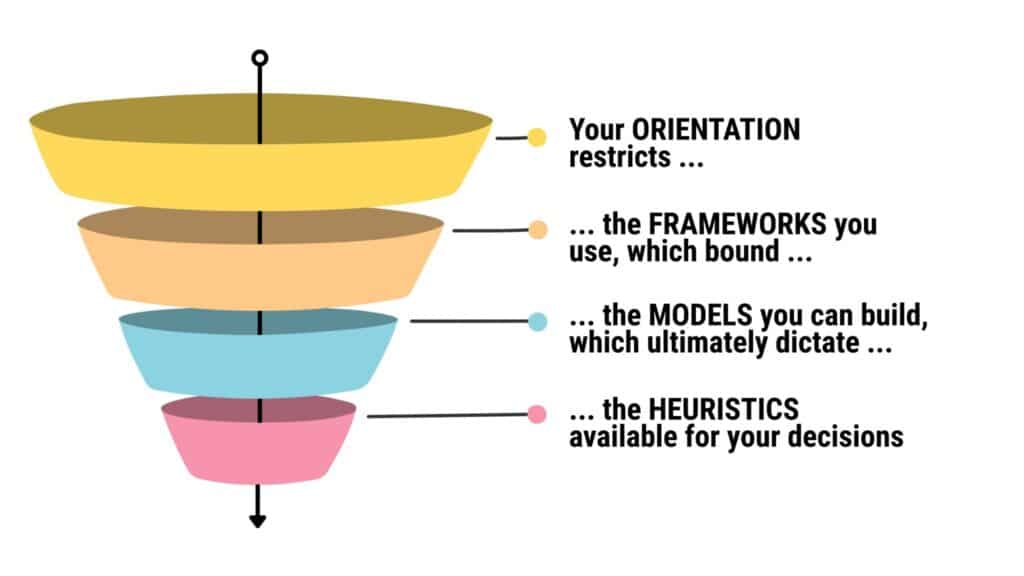
So here’s where I’ve landed: knowledge management is a nested system.
Level 1: Orientation
At the outer level — Level 1 — we have our orientation to reality. This is arguably the most important layer, as our orientation shapes what questions we can even ask — and therefore what we can see. Three general orientations are relevant here: reductionism, holism, and systems thinking.
Reductionism is appropriate at certain scales; holism at others. A good practitioner knows which level of resolution the problem calls for, and moves deliberately between them. That capacity to shift — to zoom in and zoom out as the problem demands — is the systems thinking orientation, and is the orientation I feel is most appropriate for coaches.
Take hamstring injury as an example. A reductionist orientation zooms in — to the muscle-tendon unit, fascicle length, sarcomere disruption, the local tissue mechanics that made that structure vulnerable at that moment. This is precise and necessary. But with precision comes distortion — the sharper the focus, the more we lose of what surrounds it. Reality, it turns out, is fuzzy. And the more precisely we define its edges, the more we risk mistaking the boundary for the thing itself.
Zoom out, and the picture changes. The same injury is simultaneously a movement coordination problem — how the athlete organizes hip flexion and extension under high-speed load. Zoom out again, and it’s a training load problem — the relationship between accumulated stress and tissue tolerance over days, weeks and months. Further still, and it touches upon sleep, nutrition, psychological state, and competition schedule. Each level of resolution reveals something the others cannot. A reductionist and a systems thinker looking at the same injured athlete aren’t just organizing the problem differently — they’re asking different questions entirely, and will arrive at different interventions as a result.
Level 2: Frameworks
At Level 2, we have frameworks — how we organize the problem. Periodisation is perhaps the most widely recognised example in sport: it doesn’t tell you what to do each day, it tells you how to organise training in an attempt to attain a peak performance at a certain point in time.
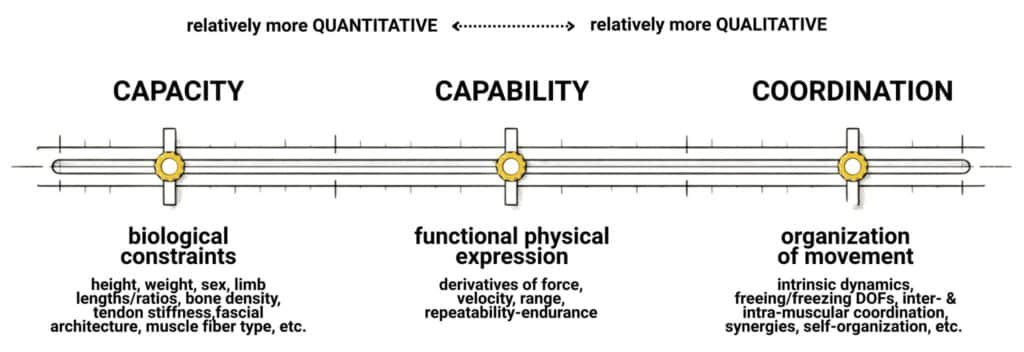
In Australia, I discussed my Capacity-Coordination Continuum, where I talked about the importance of accurately diagnosing the constraint: before acting on what you see, determine what is limiting performance — capacity, capability, or coordination — and then prescribe specific methods to target it directly. Without first understanding the nature of the constraint, we risk making a category error, attempting to solve the wrong problem entirely.
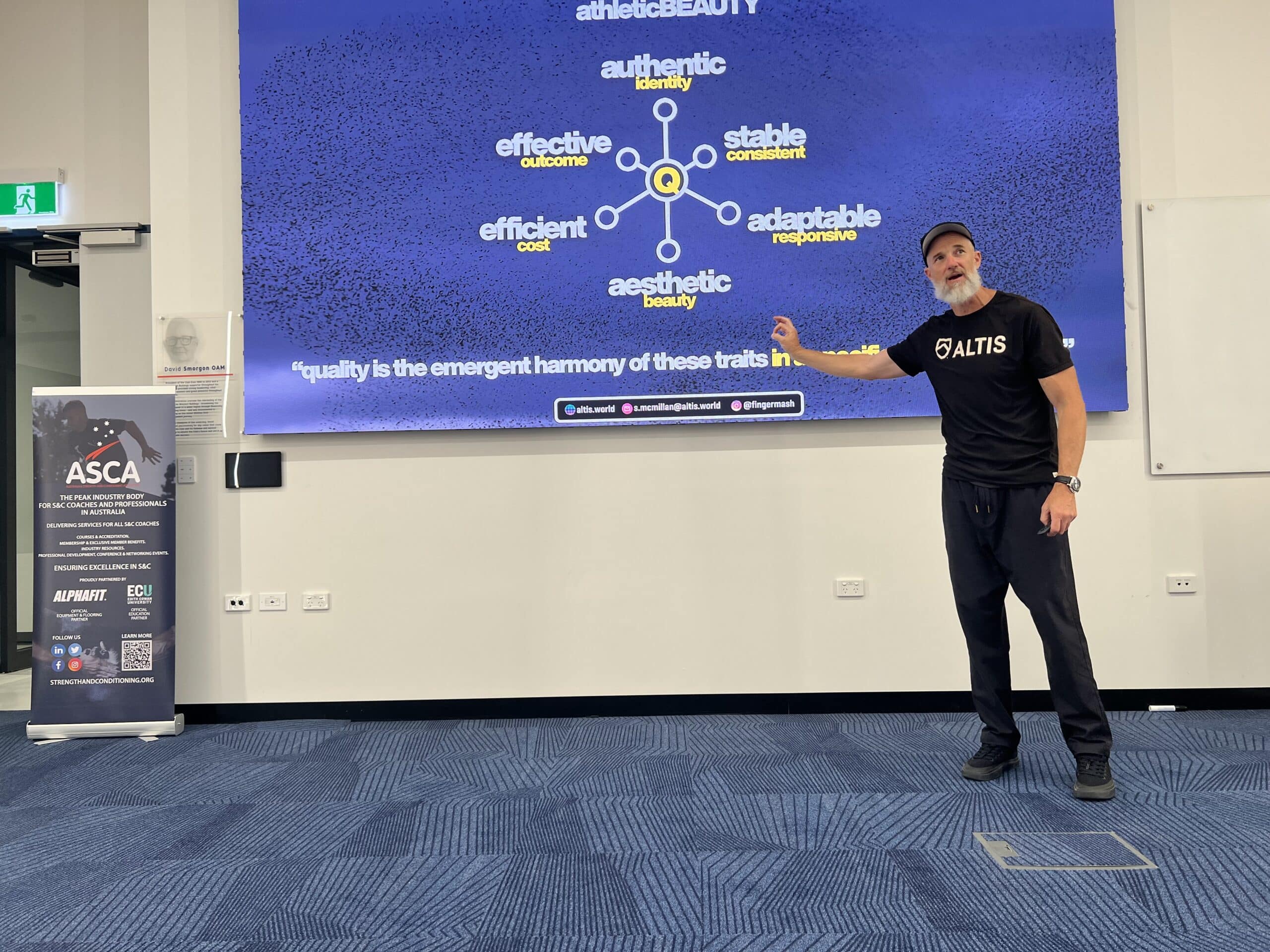
Another framework I have discussed at length over the last year is the Six-Trait Model of Movement Quality, where effectiveness, efficiency, stability, adaptability, authenticity, and aesthetic expression interact to produce something no single measure can capture. Frameworks give you perspective — a way of organising the problem space so that the right questions become visible.
Level 3: Models
At Level 3, we have models — representations of specific parts of reality. Unlike frameworks, which organize the problem space, models describe individual components within it.
The spring-mass model of running is a good example — it doesn’t describe the whole athlete, but it gives you a precise and useful picture of how the limb behaves under load.
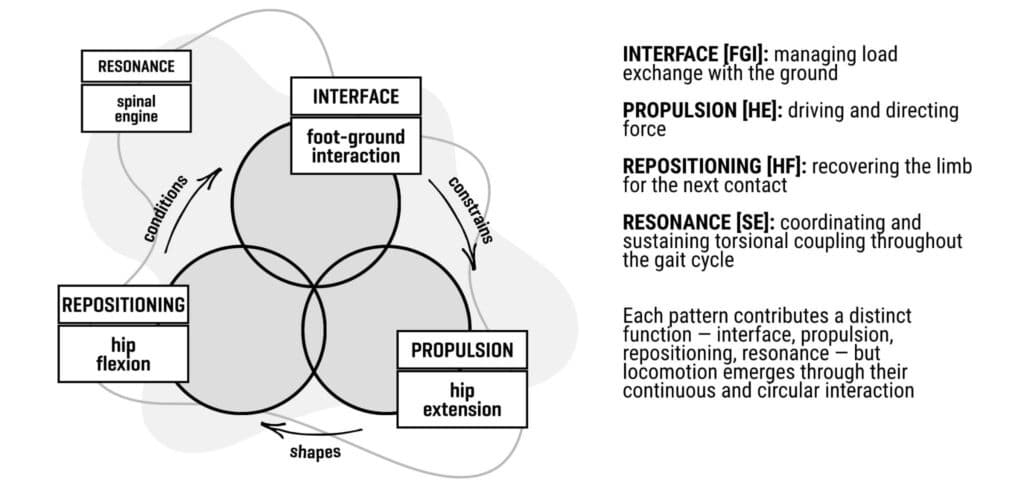
One model I have developed over many years of working with sprinters is what I call the Four Locomotion Patterns — Foot-Ground Interaction, Hip Extension, Hip Flexion, and the Spinal Engine. It doesn’t describe the whole athlete. It describes how the body solves the problem of bipedal locomotion through four coupled, interacting patterns; each pattern continuously shaping the conditions for the others.
Level 4: Heuristics and Aphorisms
Finally, at Level 4 we have heuristics and aphorisms — rules of thumb and distilled principles to inform how we act and decide in real time. George Box’s famous line sits here: “all models are wrong, some are useful.” Others that I spoke about through the ASCA Tour included:
- “Any attempt to optimize a single component part of a system comes at the expense of the system as a whole.”
- “No individual is the average of all individuals — group data can guide thinking, but it cannot prescribe action.”
- “Build towards the superpower, not the kryptonite.”
The System in Action
The nested structure may imply that each layer governs the one below it. And that’s true — but only partially. The layers don’t necessarily apply in a fixed sequence. The practitioner moves between them in a problem-specific order — and the direction depends on what the problem demands.
Let’s take hamstring injury again. In this case, the first move is perceptual — the Four Locomotion Patterns [Level 3] gives you the lens. You observe, and you identify which pattern is breaking down: is the FGI not active enough, leading to an excessive touchdown distance, and increased eccentric load upon initial contact? The model tells you where to look. Then the framework [Level 2] does the diagnostic work. For example, the Capacity-Coordination Continuum asks what kind of problem you’re actually looking at within that pattern — is it a capacity deficit, a capability gap, or a coordination failure? If it’s capability, you go one level deeper still — what does the tissue or system actually need? More force? Greater range? Different stiffness? From there, an heuristic [Level 4] governs the decision: “any attempt to optimize a single component part of a system comes at the expense of the system as a whole.” Which, in this case, reminds us to not chase the hamstring. Instead, we manage the problem in the pattern.
A Final Note
It is worth acknowledging that HAMs, for all their limitations, were immediately usable. A nested system as presented herein asks more of the practitioner — situational awareness before tool selection, and that is not a trivial cost.
But for me, this does feel closer to how coaching actually works. A more layered way of organizing, understanding and ultimately acting within complexity.